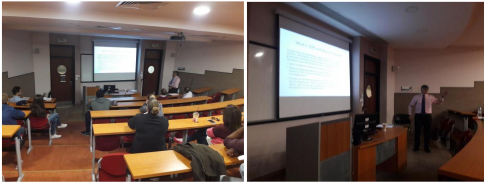
This presentation explores the critical role of Emergency Pipeline Repair Systems (EPRS) in ensuring reliable gas supply and minimizing production losses. It covers the evolution of EPRS from shallow to deepwater operations, repair tools and procedures, and the importance of planning, training, and technology development. Case studies highlight the challenges, risks, and impact of failures on company reputation and project viability.
Location
Newton Amphitheatre, University of Nicosia
Date
21st March 2019
Time
3:00 PM
Bio/Abstract
Unlike oil, where the impact of delays in delivery only postpones income, gas contracts normally stipulate penalties and any missed deliveries are deducted from the contract value and could affect the commercial viability of a project. This requirement forces all gas operators to ensure reliability of supply, either by additional parallel gas lines at a great cost or having a pipeline integrity management system demonstrating security of supply. This involves appropriate design, operation, maintenance and inspection, as well as an Emergency Pipeline Repair System (EPRS) with equipment, spares, procedures, trained people, and specialist subsea vessels that would ensure quick repairs and minimal loss of production in case of pipeline failure. This presentation will address:
- The history of EPRS, an outline of the progression from shallow water to deepwater and ultra-deepwater.
- Examples of repair tools and their functions.
- Outline procedures of typical EPRS repairs.
- The importance of having and maintaining a fully functioning EPRS, individual, club, location, priorities in case of parallel emergencies, cost and risk.
- Technology development and testing required for deepwater frontier areas as EPRS is a critical specialty and requires nerves of steel and management support when applied under stress. Years of successful EPRS go unnoticed. However, spectacular failures attract media attention and damage the reputation and share value of companies.
Mega Pipeline projects get shareholder approval only when security of supply is ensured to ALARP (As Low as Reasonably Practicable) level.
Bio
After obtaining a MSc in Underwater Science and Technology at Salford University, Theo worked for Shell for 35 years in a variety of senior roles in Underwater Project Engineering & Pipelines such as Brent in the North Sea, Ell gas in Malaysia, Major Deepwater Project Interface Management such as Bonga in Nigeria and the USA. Theo pioneered the development of non-metallic pipelines in Oman and plastic-coated Steel Catenary Risers (SCR) in Nigeria, reducing costs and risk significantly.
After retiring from Shell, Theo has been providing consultancy services as Advisor to the President of the Republic of Cyprus when the Aphrodite field was discovered, and as Engineering Manager for Worley Parsons, in Malaysia, and Principal Pipeline Advisor for Shell Gabon.
Theo championed community training & local content issues, lectured at the University of Sultan Qaboos, in Oman, Curtin University, in Malaysia, and the University of Nicosia. He is a Chartered Engineer and Fellow of the IMechE and the IMarEST. He was elected Chairman of the Greek Communities in Lagos and Great Yarmouth, where he led the operation of Greek expatriate schools and churches.