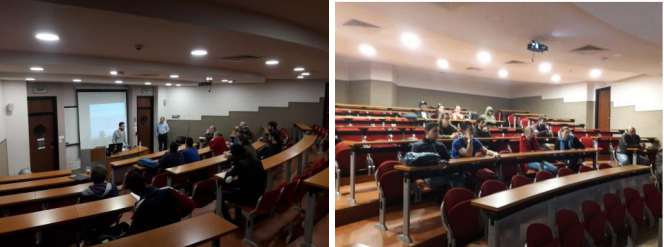

This talk reviews Eastern Mediterranean gas developments, focusing on Cyprus’s potential to become an EU gas gateway. It covers regional fields, local exploration rounds, and ExxonMobil-QP’s drilling campaigns, as well as technical, environmental, and cooperative strategies for developing ultra-deepwater gas resources and maximizing regional synergies.
Location
Newton Amphitheatre, University of Nicosia
Date
7th February 2019
Time
3:00 PM
Bio/Abstract
The loss of circulation is among the most important geomechanical issues in well engineering, as drilling fluids escape from the wellbore towards the rock formation. This event is considered a problem because it causes among others non-productive time, high costs from drilling fluids losses, stuck pipe, induced kicks or in some cases loss of the entire well. Events of loss of circulation take place when the hydraulic pressure in the well exceeds (F.I.P) fracture-initiation pressure and (F.P.P) fracture-propagation pressure of the formation, a situation very common in wells with a narrow mud window. The wellbore strengthening methods are employed to increase F.I.P or F.P.P or both so as to prevent the loss circulation.
A coupled finite element model was constructed to investigate the influence of diffusion in the fracture resistance method for wellbore strengthening. We simulate the unwanted fluid-driven fracture that is created from a narrow drilling mud window with the cohesive zone approach in a poroelastic formation. The fluid flow within the fracture is modelled by the lubrication theory assuming incompressible Newtonian viscous fluid while the fluid movement in the formation follows the Darcy law. The deformation of the porous continuum is considered to obey the Biot effective stress principal. Plugging is simulated by shutting-in the flow rate at the well and constraining the fracture aperture at a 1m distance from the well so as to allow the fluid to bleed in the formation. From the poroelastic analysis, we obtain the fracture dimensions, fluid pressures, in-situ stress change and the principal stresses during injection and plugging of the fracture. From the principal stresses, we apply a scaled Griffith criterion suitable for predicting fracture onset. It was found that during plugging, the fracture tip effectively resists propagation, however, a new fracture is suggested to develop at the plug location owing to the stress instability that is showed from the simulation. This stress instability is more profound in the poroelastic model because of diffusion effects.
Bio:
Constantinos Hadjistassou is Assistant Professor at the University of Nicosia where he heads programme in Oil and Gas Engineering. In parallel, he teaches classes pertaining to natural gas monetization, pipeline transport networks, Liquefied Natural Gas (LNG) and reservoir engineering. As of 2016, Constantinos formed the Marine & Carbon Lab (www.carbonlab.eu) which conducts research related to conventional energy sources and the marine environment. As one of the recognized experts on Eastern Med natural gas, Constantinos’ insights regularly feature in the international and local media including the Wall Street Journal, the Economist, Al-Jazeera and Bloomberg. Constantinos holds a Master’s from MIT, USA, and a DPhil from the University of Oxford, UK.